

Twelve years ago, if you had asked me about the “circular economy,” I probably would have rolled my eyes. At the time, I was leading EMEA commercial repair operations for a global lifecycle repair company, and to me, “circularity” sounded like a marketing buzzword for recycling.
I was wrong.
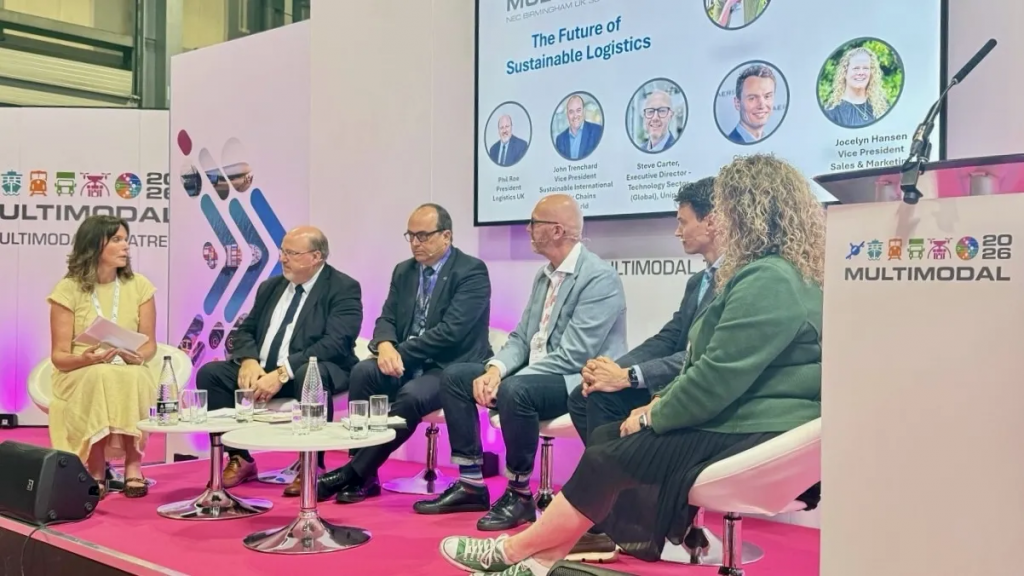
Over the last decade, my journey has transformed me from a skeptic into an evangelist for the circular economy and circular supply chain solutions. During my recent panel session at Multimodal 2026 where I joined peers from Maersk, Searoutes, and Logistics UK to discuss the future of sustainable logistics, it became clear that circularity is no longer just an “environmental initiative”. Today, it sits firmly in the boardroom at the intersection of supply chain resilience, cost control, customer experience, and commercial competitiveness.
As the industry races towards net zero, many organisations are investing heavily in electric fleets and greener transport. While these initiatives matter, they overlook one of the biggest opportunities to reduce carbon, improve resilience and lower costs: the reverse supply chain.
Many organisations are focusing almost entirely on forward logistics – buying electric delivery vans and switching to recyclable cardboard boxes. While those are positive steps, they ignore a fundamental truth: Scope 3 emissions (supply chain and product lifecycles) typically represent 80% to 90% of a technology company’s total carbon footprint.
Electric vehicles are an important part of the solution, but they aren’t the whole solution. If we’re serious about making logistics more sustainable, we need to rethink how products move through the supply chain, and that starts by looking at what is already coming back.
More importantly, circular supply chains don’t just reduce carbon. They strengthen resilience by reducing dependence on new materials, extending the life of critical assets and helping organisations respond more effectively to supply chain disruption. In an increasingly uncertain world, that’s becoming just as important as the sustainability benefits.
Shifting the mindset: From “disposal cost” to “source of inventory”
When organisations ask me where to start their circular journey, my advice is always the same: turn around and look at your reverse loop, that’s where value creation can happen.
In a traditional linear economy, returned, faulty, or end-of-life (EoL) products are treated as a headache – a line-item disposal cost on a balance sheet. In a circular economy, we must shift our mindset to see these returned assets as our most resilient, lowest-carbon source of inventory.
For technology and service fleets, e-waste and diagnostic equipment are the ultimate frontiers. When we keep these products in use longer, we avoid the carbon-heavy and resource-intensive process of extracting raw materials and manufacturing brand-new replacements from scratch.
But how do we make this transition commercially viable? By focusing on three practical, real-world pillars:
1. High-speed triage and the economics of repair
Circularity isn’t about managing waste; it’s about retaining value. Too often, perfectly functional equipment is discarded simply because an organisation lacks the diagnostic capabilities to test it upon return.
By implementing robust, localised triage at the point of return, we have generated customer savings in excess of £100k per annum simply by identifying “no-fault-found” assets and routing them straight back into active stock.
When repair is necessary, extending the life of an asset often makes far more sense than replacing it. At our repair centres, testing and recertifying an engineer’s electrical testing meter typically costs just 10–15% of the cost of a new replacement. It’s a simple example of how circularity delivers both commercial and environmental benefits.
2. Co-designing the loop: Circularity is a team sport
You cannot build a circular economy in isolation; it requires deep customer and supplier alignment. We must design logistics networks where forward delivery and reverse recovery are executed in a single, seamless, and fuel-efficient loop.
A gold standard of this in action is our work supporting major telecommunications field operations. We manage a PUDO (Pick-Up Drop-Off) locker network that services 2,000 field engineers, delivering 260,000 items monthly.
The magic happens in the exchange: 97% of engineers collect their new parts overnight from a secure locker located within an average of four miles from their home. In the very same trip, the engineer drops off the defective, replaced part into the locker. This single-trip exchange dramatically cuts travel mileage, prevents carbon emissions, and ensures that valuable, repairable assets are returned to our repair center days faster than traditional, fragmented networks. As an added benefit, this close-loop collaboration allowed us to completely eliminate 120+ tonnes of single-use plastics by working with the downstream vendors and using reusable transit packaging, all of which is tracked to the engineer.
3. Banishing the “Van Graveyard” via technician empowerment
The absolute bottleneck of any circular service network is the front-line engineer. If your technicians are left to their own devices, defective or end-of-life assets inevitably pile up in the back of service vans – what I call the dreaded “van inventory graveyard”.
Your engineers are the gatekeepers of your circular economy. They make the split-second decision on whether a part is tossed in the bin or returned to the loop.
We must empower them with digital tools. Mobile field engineer apps can treat each technician’s vehicle as a live, tracked inventory location. The moment a replaced component is scanned, the app guides the engineer to the next step: whether that’s repair, remanufacture, or harvest for high-grade recycling. Combined with ongoing training and data-driven insights, this helps prevent unnecessary stockpiling, optimise part utilisation, and keep valuable materials flowing through the circular supply chain.
Stop designing “perfect” systems – Start with a proof of concept
The biggest threat to sustainability in logistics is analysis paralysis. Organisations frequently get stuck trying to map out a “perfect” end-to-end circular model before launching a single initiative.
The solution is to start small, prove the economics, and scale fast.
Bring your suppliers, floor staff, and partners together for focused, cross-functional innovation workshops. Identify a localised, low-cost pilot – for example, testing a closed-loop parts swap with a regional team of 50 field engineers. Measure the fuel savings, calculate the carbon reduction, and track the capital recovered from reconditioned parts. Once you have demonstrated the commercial and environmental returns to the board, scaling nationwide becomes a natural next step.
Ten years ago, we had to justify sustainability purely because it was “the right thing to do”. Today, the commercial case has caught up with the environmental case. Operational circularity reduces costs, protects your supply chain against geopolitical and material disruptions, and delights your customers.
When we design systems that eliminate waste, keep products in use longer, and optimise every mile, sustainability simply becomes the natural outcome of running an excellent supply chain.
Discover how circular operations can create commercial and environmental value.