
Left
Driving quality excellence:
Benefits of IATF 16949 & no-fault-forward manufacturing
Electrification is reshaping products and manufacturing requirements across sectors from automotive and rail, to defence, marine, energy and industrial applications. As technologies move from development into production, the challenge is no longer simply whether they work, but whether they can be manufactured safely, consistently and repeatedly.
The pace of this transition is already evident in established industries. In automotive, for example, the latest SMMT figures show that electrified models accounted for more than four in ten cars manufactured in the UK in July 2026, with output rising 6.8% year-on-year.
For manufacturers across sectors, that shift puts greater emphasis on the disciplines behind production: robust process control, traceability, defect prevention and quality built into the manufacturing process from the outset.
Unipart brings decades of safety-critical manufacturing experience to electrification, with capability spanning battery systems, power electronics, wiring and electrical systems, advanced manufacturing, and lifecycle support.
Our approach combines rigorous quality disciplines with advanced manufacturing technologies, including no-fault-forward systems, to build quality and process control into production from the outset. For our customers, that means greater confidence in the safety, consistency, and repeatability of complex electrified products as they move into manufacture.
The importance of IATF 16949 in our quality strategy
IATF 16949 is the globally recognised quality management standard for the automotive sector. It provides a structured framework for continuous improvement, defect prevention, and waste reduction throughout the supply chain.
By integrating IATF 16949 principles into our operations, our customers benefit from:
- Robust Quality Management Systems (QMS): Standardised processes drive consistency and efficiency across production lines.
- Defect prevention: A proactive approach minimises the risk of failures before they reach the customer.
- Customer satisfaction: Aligned with stringent quality expectations and reinforced by a commitment to reliability and performance.
- Supplier excellence: Stringent supplier controls and audits ensure that components meet the necessary specifications.
Unipart’s approach is underpinned by rigorous quality disciplines and a continuous improvement culture developed through decades of safety-critical, complex automotive manufacturing experience. We apply this manufacturing discipline across electrification programmes, bringing automotive-grade process control, traceability, and repeatability to safety-critical applications across sectors.
Building quality into the process: No-fault-forward manufacturing
No-fault-forward manufacturing is designed around a simple principle: non-conforming work should be identified and contained at the point it occurs, rather than allowed to progress through the production process.
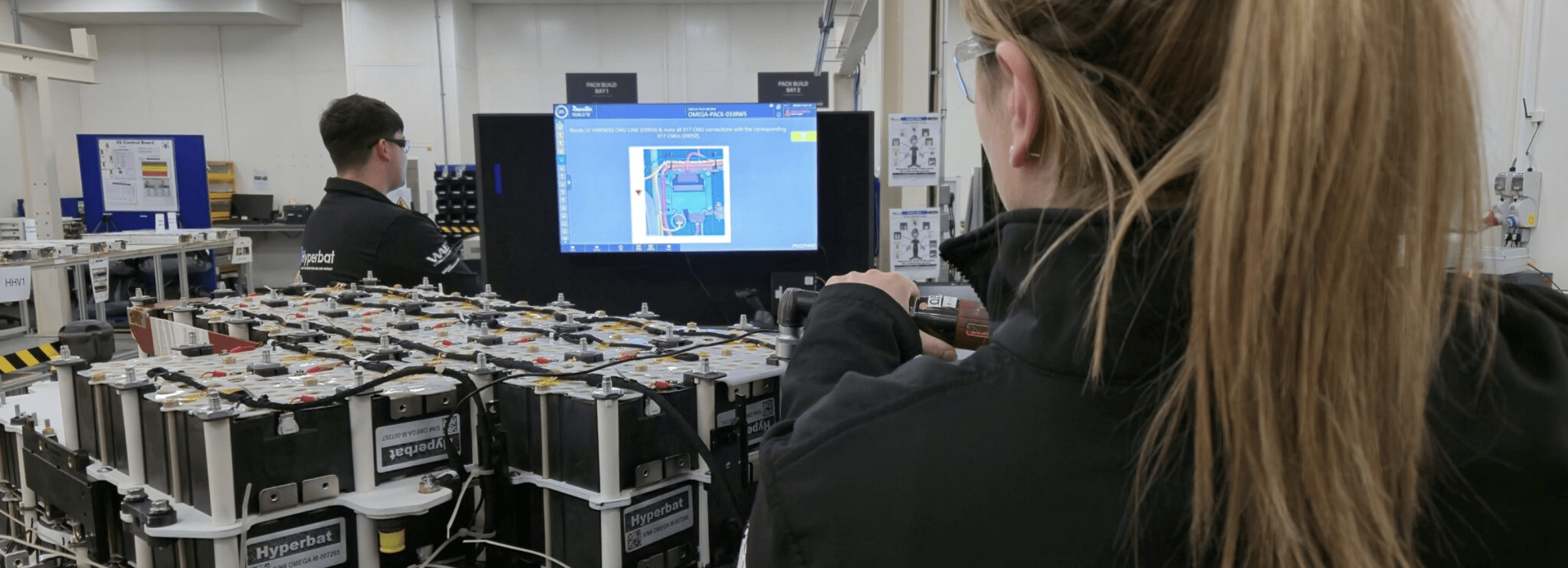
Aligned with the principles of IATF 16949, our advanced production control systems combine predefined assembly sequences, real-time verification and error-proofing to control how critical manufacturing processes are completed. This creates a controlled, traceable production environment, enabling issues to be identified and addressed at source.
100% of critical process steps digitally verified
For customers, this provides greater confidence in process consistency while reducing the risk of rework, disruption and manufacturing variation.
- Process control & verification: Predefined assembly sequences ensure manual and automotive steps are completed and digitally verified before progression, ensuring required process stages cannot be bypassed.
- Error-proofing (Poka-Yoke): The system detects incorrect operations in real time, prompting immediate corrective actions.
- Traceability & data collection: Each unit’s assembly history is logged, ensuring complete transparency and compliance with quality standards.
- Enhanced operator guidance: Step-by-step instructions reduce human error, improving both efficiency and accuracy.
Together, these controls create a manufacturing environment where quality is actively managed throughout production, rather than relying on final inspection. The resulting data gives customers greater transparency, supports faster root-cause analysis and provides confidence in how complex products are manufactured and tested.
Manufacturing data is becoming increasingly valuable beyond the production line
From 18 February 2027, EU Battery Passport requirements will introduce new obligations for relevant batteries, including information covering performance, durability, and lifecycle status. Building robust traceability and data capture into manufacturing today helps create the foundations businesses will need for greater transparency, compliance, and lifecycle management tomorrow.
Across battery systems, power electronics, wiring, and electrical systems, we apply this rigorous approach to help customers industrialise electrification technologies with greater confidence, whatever the application or sector.
Conformity of production & homologation expertise
Moving a product into production means ensuring it continues to meet its approved specification, not just at initial validation, but throughout manufacture. Conformity of Production (CoP) and homologation provide the framework for maintaining that consistency and demonstrating compliance with applicable regulatory requirements.
Unipart brings CoP and homologation expertise to electrification manufacturing, integrating validation, inspection and testing into production to support integrity, safety, performance and regulatory requirements as technologies move into repeatable manufacture.
Automotive-grade discipline applied across sectors
The principles behind rigorous manufacturing quality are not limited to one application or sector. Process control, traceability, repeatability, defect containment, and continuous improvement are fundamental wherever complex, safety-critical electrification technologies are manufactured.
Unipart applies these disciplines across a growing range of electrification applications, supported by capability spanning battery systems and energy storage, power electronics, wiring and electrical systems, advanced manufacturing, supply chain integration, and lifecycle services.
Delivering quality, safety, and performance for our customers
By embedding process control, verification, traceability and data capture throughout production, we give customers greater confidence in how their products are manufactured, tested and controlled, while supporting faster root-cause analysis and reducing the risk of issues progressing downstream.
Talk to us about your electrification manufacturing challenge or arrange a visit to see our capability in action.