Global insights from the rail supply chain
From Darren Leigh
Global insights from the rail supply chain
From Darren Leigh
Darren Leigh’s global insights from the rail supply chain
This article was published in Rail Express
In today’s increasingly challenging rail environment, mastering supply chain complexity is not just a cost-saving exercise, but a source of competitive edge.
And at the heart of that complexity is something many people in the rail industry know well – volatility.
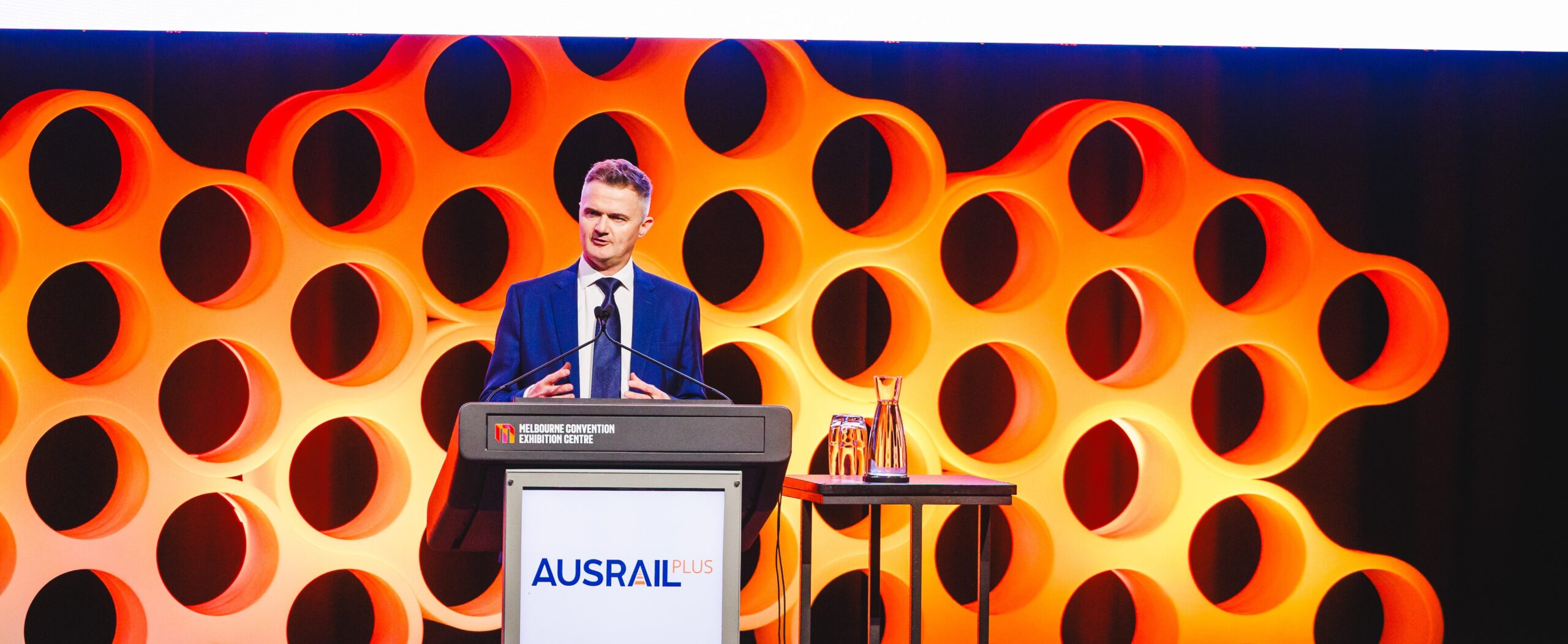
That was the message Darren Leigh, Chief Executive Officer (CEO) of Unipart, shared with the audience at the recent AusRAIL PLUS conference in Melbourne.
“If you ask any CEO today what keeps them up at night, it’s the sheer unpredictability of the world we operate in,” he said.
“We are navigating a permanent state of volatility, and our industry, rail, is uniquely exposed.”
For more than 50 years, Unipart has been a performance improvement partner to some of the world’s most complex and mission-critical organisations – designing, making, moving and improving components in its customers’ supply chains.
Leigh said that operating in 22 countries and serving customers in more than 100 gives the company a unique view from the watchtower.
“From Sydney to London and from New York to Dubai, universal challenges are impacting supply chains,” he said.
“These challenges include geopolitical friction that turns proven trade routes and sourcing strategies upside down overnight, increasing extreme weather events and of course, the post-pandemic shifts in how people move and how freight is prioritised.”
But the greatest challenge facing the rail industry right now is the endless cycle of “boom and bust” funding, he shared.
“This stop-start investment stifles long-term planning, forces short-term maintenance decisions over long-term asset renewal, and tragically, creates a brain drain of skilled professionals who seek greater stability elsewhere.”
From reactive to predictive
Leigh said that Unipart’s conversations with customers around the world have fundamentally changed, signalling a vital evolution in the industry.
“The initial request has moved from: ‘Can you supply this part?’ to: ‘How can you help us improve our performance and navigate this volatility?’” he said.
“This demonstrates the shift from a transactional supplier-customer model to a deeply strategic partnership model.”
Leigh said this change has taken place because the old model of managing failure is no longer sustainable.
He reminded the audience that assets do not exist in isolation; they are part of a complex, interacting ecosystem of power, environment, and logistics.
“Think about the classic ripple effect of failure: a component on a piece of rolling stock fails, which stops a train,” he said. “But it doesn’t end there. The ripple spreads.
“It’s the passengers who miss connections, the engineer whose schedule collapses, the depot that goes out of sync, and the supplier who is now scrambling to provide a product that was unplanned.
“Valuable time and asset availability are lost, because when monitoring and maintenance aren’t perfectly aligned, it’s like trying to solve a jigsaw puzzle with half the pieces missing.”
Leigh said Unipart’s customers are no longer just looking for a better product, but data-driven insights to help them find the missing pieces of the jigsaw.
“They need a system that doesn’t just react to failure but anticipates it, and then instantly mobilises the entire support ecosystem around that prediction.”
The Condition-Based Supply Chain
Many people in the rail industry will be familiar with predictive maintenance – when tools and technology are used to predict failures before they happen.
Leigh said the “next great leap” in supply chain performance involves taking insights from predictive maintenance and transforming them into automated action across the entire service chain.
This system, which he called “the Condition-Based Supply Chain”, means data is streamed in real-time from assets, and artificial intelligence predicts not just if it will fail, but when and why.
“This prediction automatically triggers the entire supply chain: the right part, the right tool, and the right engineer are deployed, precisely when and where they are needed,” he said.
“This is where the supply chain moves from a cost centre to a source of network resilience.”
Leigh said the Condition-Based Supply Chain delivers a complete loop: from sensor, to insight, to logistics, to component refurbishment.
“It’s a unified system of anticipation, precision, and resilience that allows you to manage assets based on real-world need, not arbitrary timetables.
“The benefits are profound – from reduced costs due to eliminating unnecessary maintenance and downtime, to enhanced reliability and improved sustainability thanks to the optimisation of energy use and extending the life of critical assets.”
He shared an example of the power of real-time condition monitoring insights from Unipart’s work with Northern Trains, one of the largest rolling stock operators in the United Kingdom.
Unipart deployed remote condition monitoring across the customer’s Porterbrook Class 170 Turbostar fleet, using sensor technology to install systems that continuously monitor things such as oil pressure and coolant levels.
Leigh said the result was “immediate and measurable”, with issues now detected early and diagnosed precisely.
“The result was fewer faults, reduced maintenance time, and significantly increased availability because assets spend more time in service,” he said.
To demonstrate the power of logistics, MRO (maintenance, repair and operations) and supply working together, he shared a further example from Network Rail, the organisation that owns, operates, maintains, and develops the railway infrastructure in England, Scotland, and Wales.
Unipart supplied new point machines to Network Rail, but its work didn’t end there.
“We created an end-to-end refurbishment process that re-engineered old point machines in-house,” said Leigh.
“The result was a 50 per cent cost saving versus buying new units, a 15-month warranty – longer than a new machine – and better availability, as components could be returned to service quickly.”
Culture and collaboration
Leigh stressed that although technology brings many benefits for the rail industry, it’s not going to fix everything.
He said that the Condition-Based Supply Chain (CBSC) is a framework, and every framework requires firm foundations. For Unipart, these are based on culture and collaboration.
“At Unipart, we call culture ‘The Unipart Way’,” he said. “It is a proprietary business system, and a unique culture of continuous improvement built over five decades.
“It’s what empowers every single colleague – from the shop floor to the boardroom – to challenge the norm and continuously drive improvements.
“It is this culture that allows us to not just embrace new technology, but to pioneer it, and to partner with our customers to build the future skills needed to support it.”
Turning to collaboration, Leigh said the rail industry must move away from short-term, transactional procurement if it is to become truly resilient, sustainable and connected.
“We must embrace long-term partnership models that foster trust, share risk, and create genuine win-win scenarios,” he said.
“It requires open data sharing. It requires long-term commitment. And it requires the courage to innovate together.”